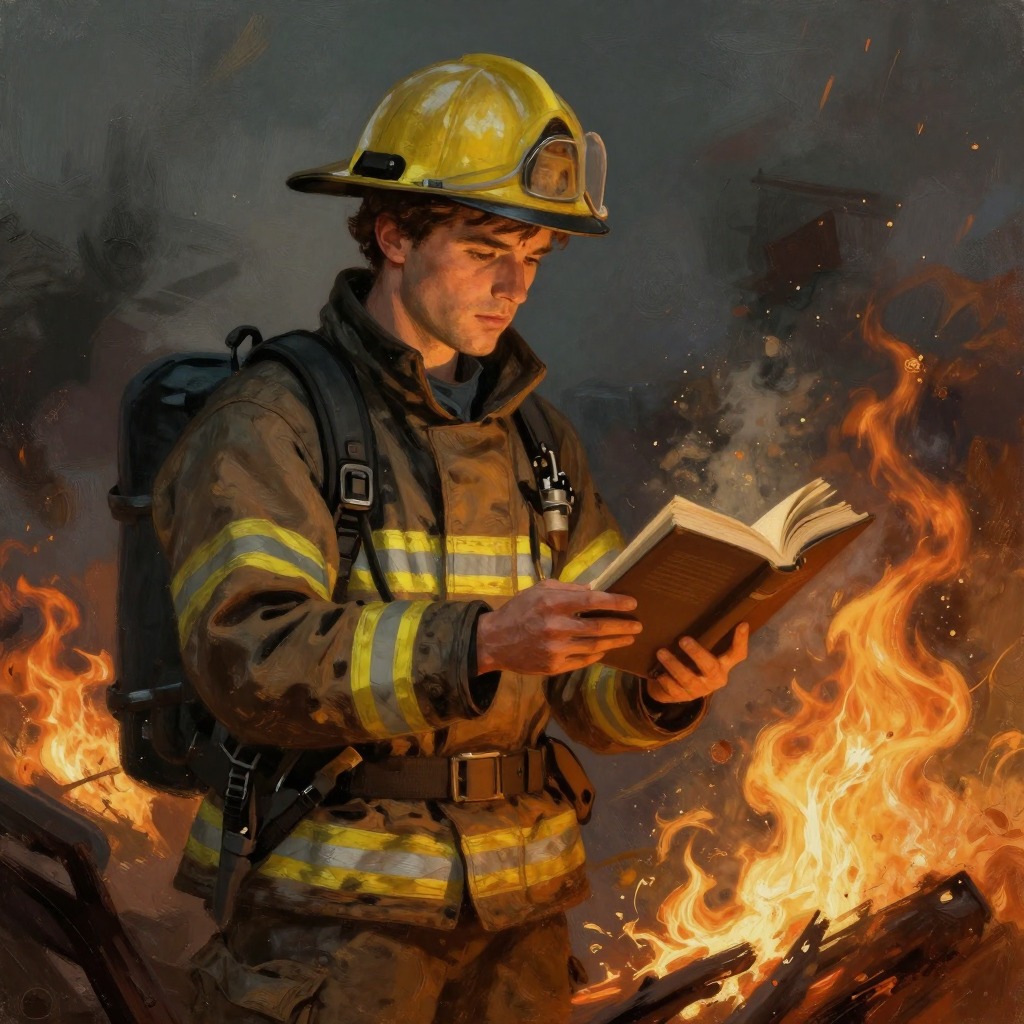
early in the story, a night in autumn
Montag meets Clarisse McClellan
Guy Montag, a fireman who burns books for a living, encounters a seventeen-year-old girl named Clarisse McClellan while walking home from work. Clarisse is a curious and observant young woman who asks Montag questions about his job and his happiness, challenging his assumptions about the world. She tells him about her love for nature, walking, and thinking, and mentions that her family is considered peculiar because they talk and sit together. Montag is both unsettled and intrigued by her, and her question "Are you happy?" lingers in his mind, planting the first seed of doubt about his life.
later that same night
Montag discovers Mildred's overdose
After his encounter with Clarisse, Montag enters his bedroom and finds his wife, Mildred Montag, lying in bed with Seashell Radios in her ears, staring blankly at the ceiling. He notices an empty bottle of Sleeping Pills on the floor and realizes she has overdosed. He calls for medical help, and two cynical technicians arrive with a machine called the Black Cobra, which pumps her stomach and replaces her blood. The technicians treat the situation with cold indifference, reflecting the society's desensitization to such events. Montag is deeply shaken by the incident and the emptiness of his marriage.
the following days
Montag's growing unease
In the days following Mildred's overdose, Montag becomes increasingly disturbed by his life and his society. He continues to meet Clarisse, who shares her observations about the world, such as the lack of meaningful conversation, the speed of life, and the dangers of their culture. Montag begins to question his role as a fireman and the values of his society. He also notices the Mechanical Hound in the firehouse acting strangely toward him, which he interprets as a threat. His conversations with Clarisse and his own reflections lead him to feel a growing sense of dissatisfaction and alienation.
after a week of meetings
Clarisse disappears
After a week of daily encounters, Clarisse suddenly stops appearing. Montag notices her absence and feels a sense of loss and unease. He asks Mildred about her, and Mildred casually mentions that Clarisse is gone, possibly dead, run over by a car. The family has moved away. Montag is shocked and saddened by the news, and he realizes that Clarisse's death has been treated as insignificant by his wife and society. This event deepens his crisis of conscience and his desire to understand the world he lives in.
a night shortly after Clarisse's disappearance
Burning of the old woman
Montag and the other firemen respond to an alarm at an old house. Inside, they find an elderly woman who refuses to leave her books. She quotes the martyr Hugh Latimer, saying "Play the man, Master Ridley; we shall this day light such a candle, by God's grace, in England, as I trust shall never be put out." Despite Montag's pleas, she refuses to leave and sets herself on fire with a match, choosing to die with her books. Montag is horrified by her sacrifice and secretly steals a book from the scene, hiding it under his coat. This event marks a turning point in Montag's rebellion against his society.
later that night
Montag hides the stolen book
After returning home from the burning, Montag hides the stolen book under his pillow. He feels a mixture of guilt and excitement, and he struggles with his conscience. He tries to talk to Mildred about the woman's death and the meaning of books, but she is dismissive and more interested in her television programs. Montag realizes the depth of the emotional and intellectual void in his marriage and his life. He begins to feel that books might hold the answers he is seeking.
the next day
Captain Beatty's visit
Captain Beatty visits Montag at home, suspecting his crisis of conscience. Beatty delivers a long monologue explaining the history and philosophy of their society, arguing that books cause unhappiness and conflict, and that firemen are the guardians of happiness and peace. He claims that the system evolved naturally from the desire for equality and the avoidance of offense. Beatty's speech is both persuasive and intimidating, and Montag feels confused and trapped. Beatty also reveals that he knows about the stolen book and gives Montag 24 hours to burn it, or the firemen will do it for him.
after Beatty's visit
Montag reveals his hidden books
After Beatty leaves, Montag decides to show Mildred the collection of books he has been secretly hoarding over the past year. He retrieves them from the ventilator grille and reveals about twenty books. Mildred is horrified and tries to burn them, but Montag stops her. He pleads with her to help him understand the books and to give him 48 hours to see if they contain anything meaningful. Mildred reluctantly agrees, but her fear and loyalty to the system are evident.
the same afternoon
Montag reads the Bible
Montag and Mildred spend the afternoon reading the Bible, specifically the Book of Ecclesiastes. Montag struggles to understand the text, but he is drawn to its depth and meaning. Mildred is dismissive, finding the words confusing and irrelevant. Montag feels a growing connection to the ideas in the book and a desire to learn more. He realizes that he needs a teacher to help him understand what he reads.
later that afternoon
Montag contacts Professor Faber
Remembering a retired English professor he met in the park a year ago, Montag calls Professor Faber. He asks Faber about the number of copies of the Bible and other books left in the country. Faber is initially suspicious and hangs up, but Montag persists. He visits Faber at his home, where he confesses his crisis and asks for help in understanding books. Faber agrees to help, but he is cautious and fearful. He gives Montag a Green Bullet, a two-way radio device that allows them to communicate secretly.
during Montag's visit to Faber
Faber's three missing things
Faber explains to Montag that books themselves are not the solution; what is missing are three things: quality of information, leisure to digest it, and the right to act on what one learns. He argues that society lacks these elements, and that books are merely a repository for them. Faber also reveals his own cowardice and his plan to use the Green Bullet to spy on the firemen. He and Montag discuss a plan to plant books in firemen's houses and turn in alarms to undermine the system.
that evening
Montag reads poetry to the women
Mildred invites her friends, Mrs. Phelps and Mrs. Bowles, over to watch television. Montag, frustrated by their shallow conversation, decides to read them a poem from his stolen book. He reads Matthew Arnold's "Dover Beach," which speaks of the loss of faith and the darkness of the world. The poem deeply affects Mrs. Phelps, who begins to cry, while Mrs. Bowles is angry and offended. The women leave in distress, and Montag realizes the power of literature to evoke genuine emotion, but also the danger of challenging the status quo.
later that night
Montag returns to the firehouse
After the incident with the women, Montag goes to the firehouse for his shift. He is nervous and guilty, but he tries to act normal. Captain Beatty engages him in a philosophical debate, quoting literature to confuse and intimidate him. Beatty seems to know about Montag's secret activities and taunts him. Montag feels trapped and desperate, but he is determined to continue his rebellion. The alarm rings, and the firemen respond to a call.
the same night
Montag's house is burned
The firemen arrive at the address of the alarm, which turns out to be Montag's own house. Mildred has turned in the alarm and is leaving with a suitcase. Beatty forces Montag to burn his own house with a Flamethrower. Montag complies, destroying his home and all his possessions. After the house is reduced to ashes, Beatty arrests Montag and reveals that he knows about the Green Bullet. Montag, in a fit of rage and desperation, turns the flamethrower on Beatty and kills him.
immediately after killing Beatty
Montag kills the Mechanical Hound
After killing Beatty, Montag is attacked by the Mechanical Hound, which has been sent to capture him. The Hound injects a needle into his leg, but Montag manages to destroy it with the flamethrower. He is injured and in pain, but he escapes into the night. The other firemen are unconscious, and Montag is now a fugitive. He limps away from the scene, carrying a few books he had hidden in the garden.
during his escape
Montag plants books in a fireman's house
As Montag flees, he remembers his plan to plant books in firemen's houses. He stops at the house of a fireman named Black and hides four books in the kitchen. He then calls in an alarm from a phone booth, hoping to set off a chain reaction that will expose the firemen's hypocrisy. This act is a desperate attempt to strike back at the system that has destroyed his life.
later that night
Montag visits Faber
Montag makes his way to Faber's house, where he tells the old man what has happened. Faber is shocked but supportive. He gives Montag money and advice on how to escape. Faber plans to leave for St. Louis to meet a retired printer. Montag changes into Faber's old clothes and uses whisky to mask his scent from the Hound. He then heads toward the river, following Faber's instructions.
early morning
Escape across the boulevard
Montag crosses a wide, empty boulevard, knowing that police helicopters and the Mechanical Hound are searching for him. He is nearly hit by a car full of teenagers who are joyriding and trying to run him over. He manages to reach the other side and continues toward the river. The city is in chaos, with police and helicopters searching for him. Montag's escape is a harrowing test of his will to survive.
dawn
Montag escapes into the river
Montag reaches the river and wades in, stripping off his clothes and washing himself with whisky to throw off the Hound's scent. He puts on Faber's old clothes and floats downstream, leaving the city behind. The Hound and helicopters lose his trail and eventually give up the chase, settling for a scapegoat. Montag feels a sense of peace and freedom as he drifts away from the oppressive society.
after dawn
Meeting with Granger and the book people
After floating down the river, Montag comes ashore and follows a railroad track into the countryside. He encounters a group of men sitting around a campfire, led by a man named Granger. They are a community of intellectuals who have memorized books to preserve knowledge. Granger explains that they are "book-burners" in a different sense: they have burned the physical books to avoid detection, but they carry the texts in their minds. Montag is welcomed into their group and learns that he is now the Book of Ecclesiastes.
later that morning
The city is bombed
As Montag and the wanderers sit by the fire, the war that has been threatening finally erupts. Jets fly overhead, and the city is destroyed by bombs. Montag witnesses the annihilation of the city, including his wife Mildred, who is killed in the blast. He feels a mix of grief and relief, and he remembers his past with Mildred. The bombing marks the end of the old world and the beginning of a new one.
after the bombing
Montag joins the wanderers
After the bombing, Granger and the other men prepare to move upstream. They share a meal and discuss the future. Granger tells Montag about the Phoenix myth and the importance of remembering the past to avoid repeating mistakes. Montag realizes that his role is to preserve and share the knowledge he carries. He joins the group as they begin their journey north, ready to help rebuild a better world.
during the walk
Montag remembers Ecclesiastes
As the group walks along the river, Montag reflects on the Book of Ecclesiastes, which he has memorized. He recalls the passage about a time for everything and the tree of life. He feels a sense of purpose and hope, knowing that he can contribute to the preservation of human knowledge. The novel ends with Montag looking forward to the future, ready to share what he has learned.